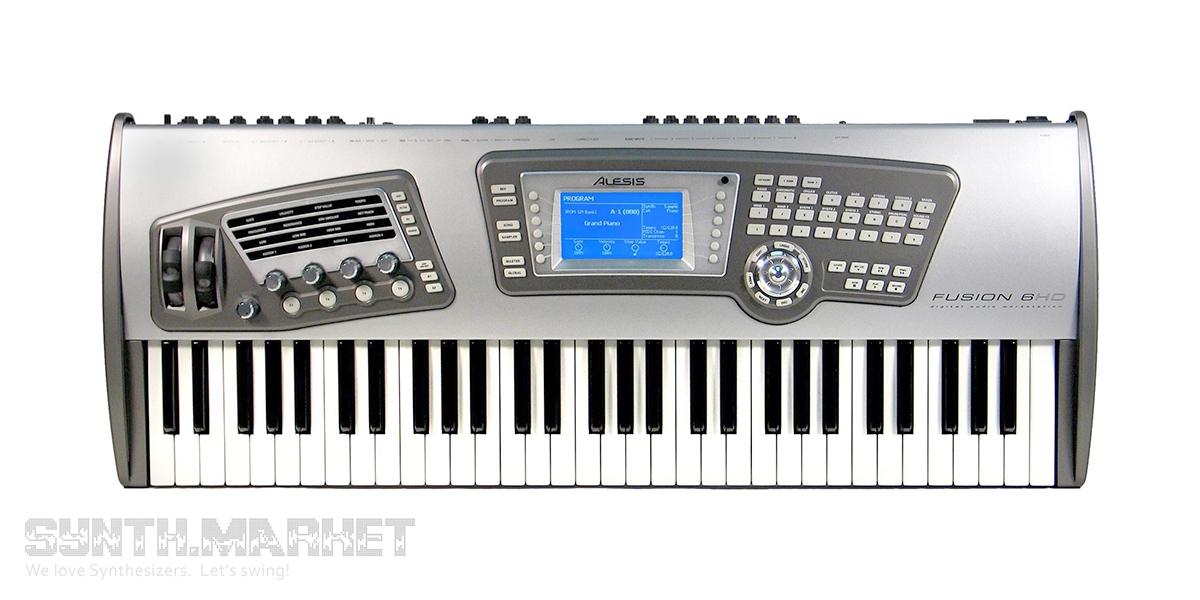
The Alesis Fusion represented the Alesis's ambitious entry into the hardware workstation synthesizer market, launched at NAMM 2005 and officially shipping in 2006. The Fusion was available in two models — the 61-key Fusion 6HD and the 88-key weighted Fusion 8HD. This sleek, silver instrument aims to deliver a comprehensive music production solution in a single, self-contained package.
Design Philosophy
The Fusion challenges the growing dominance of computer-based music production by offering a thoroughly modern workstation that combines multiple synthesis technologies, sampling capabilities, sequencing, and hard disk recording. Its architecture centers around a software-based, updatable operating system and a 40GB hard drive, providing flexibility similar to computer-based systems while maintaining the immediacy and tactile control of dedicated hardware.
Aesthetic and Interface
Described as having "understated sex appeal" with its sleek silver body and "future retro" styling, the Fusion makes a striking visual impression. Every button is backlit, creating a starship command console effect when powered on. Active buttons glow brighter than inactive ones for instant visual feedback. The pitch and modulation levers illuminate in neon blue when moved—both a stylish touch and a practical feature for dark performance environments.
The control layout is exceptionally logical: real-time performance controls sit on the left, preset selection and data navigation controls occupy the center around the generous 240×128 high-definition backlit LCD, and transport controls for the sequencer and recorder are positioned on the right. The system is organized into six main "Modes": Mix, Program, Song, Sampler, Mixer, and Global.
Four Synthesis Technologies
The Fusion's most distinctive feature is its incorporation of four different synthesis methods within a single instrument:
1. Sample & Synthesis (S&S)
The foundation of the Fusion's sound palette uses samples stored in Flash ROM that can be substituted with others from the internal hard drive or Flash ROM, creating access to a massive, ever-changing library. Melodic programs support up to four oscillators (as of OS v1.20), each containing a multisample. The system initially offered three filter types, expanding to seven with OS v1.20, including an analogue-like four-pole filter and three formant filter types. Drum programs can use up to four velocity-crossfaded samples, 64 oscillators per note, and 256 samples per program, with 64 filters total.
2. Virtual Analogue Synthesis
Offers subtractive synthesis with up to three basic waveforms per voice, including sawtooth, pulse, sine, and various noise types (white, pink, red), plus the ability to process incoming audio from sample inputs. Twenty-six filter types are available per voice.
3. FM Synthesis
A flexible six-operator implementation similar to the Yamaha DX7, but enhanced with six basic waveform types per operator (though initially limited to sine-wave variants plus white noise). Like virtual analogue, it provides 26 filter types per voice.
4. Physical Modelling
Perhaps the most unusual feature for a hardware workstation at this price point, the Fusion implements two physical models:
Reed Model: Simulates reed instruments with parameters for Breath, Noise, Threshold, Slope, Curve, Frequency, Mix, Gain, and Bore Filter. The first two parameters relate to energy input, the next three to energy transfer to the reed, and the final four to the resonator (bore) that converts reed vibrations into sound waves.
Wind Model: Similar structure to the reed model but uses a mouthpiece as the driver, with parameters including Breath, Noise, Jet, Curve, Offset, Frequency, Mix, and Gain.
All synthesis types offer up to eight envelopes (for volume, filter, or pitch) and up to eight LFOs.
Sound Library and Expandability
The Fusion ships with 800 preset programs, 64 drum kits, 128 General MIDI programs (with eight drum kits), and 128 Mixes (multitimbral setups). While the initial factory soundset received mixed reviews for being somewhat lacklustre and not fully exploiting the four synthesis technologies, Alesis addressed this through regular downloadable preset banks, many created by UK sound designer Hollow Sun (Steve Howell). These additions—including electric pianos, organs, strings, choirs, and drum kits—significantly improved the instrument's sonic palette.
The preset organization system is quirky but workable: sounds are organized by type (Piano, Chromatic, Organ, etc.) like a General MIDI synth, allowing users to work sequentially through instrument types or jump between banks to access specific categories. User-created patches can be labeled by type to integrate into this system. The trade-off is load time—calling up a new preset from the hard disk takes a second or two as it displaces an older one in the 64MB Flash ROM.
Polyphony and Voice Architecture
Unlike traditional workstations with fixed polyphony counts, the Fusion uses its dual TI processor sound engine dynamically, with voice counts varying by synthesis complexity:
- Sample Playback: 272 voices total (136 per engine)
- FM Synthesis: 240 voices total (120 per engine)
- Virtual Analogue: 140 voices total (70 per engine)
- Physical Model (Reed): 60 voices total (30 per engine)
- Physical Model (Wind): 48 voices total (24 per engine)
Performance Controls
The Performance Grid (control matrix) offers sophisticated real-time control with four chunky continuous controller knobs, four programmable trigger buttons, and two on/off switches. The mapping is controlled by four switches—Arp, Filter, EQ, and Assign—providing a matrix approach where the first three lines hardwire knobs to specific parameters while the Assign row offers four user-programmable parameters.
Arpeggiator
The arpeggiator deserves special mention as it goes far beyond typical implementations. With 1,000 preset patterns and unlimited user-programmable patterns (limited only by hard disk space), it ranges from traditional up/down bleepy patterns to "Phrase Arpeggiations" that mimic playing styles like guitar strumming, plus pre-programmed drum patterns that effectively give the Fusion built-in drum machine functionality. Each patch has a dedicated button to toggle the arpeggiator on and off, keeping it immediately accessible rather than buried in menus.
Effects Processing
The Fusion provides comprehensive effects processing with 57 insert effects (up to four inserts per program) and 64 buss effects (up to two busses per program, mix, or song), plus a four-band master EQ. Effect types include reverb, delay, modulation effects, dynamics processors, and guitar amp models.
Sampling Capabilities
The standard 64MB memory provides 11 minutes, 53 seconds of sampling time at 44.1kHz/16-bit (mono), expandable to 192MB for 37 minutes, 15 seconds with optional RAM expansion. Sampling is handled via dedicated stereo or mono inputs on the back panel with adjustable gain control capable of handling line signals or dynamic microphones. The interface includes virtual bar-graph meters for level setting and a variable threshold control for triggered recording.
The Sample Edit screen offers comprehensive manipulation including gain adjustment, normalizing, cropping, loop point setting, cut and paste, fade ins/outs, reverse, and quantize (for bit-depth reduction effects). Multisamples can be built with up to 512 component samples.
The free Fusion Converter utility (PC-only at review time, Mac version in development) enables import of WAV and AIFF files, Soundfont files, and Akai S1000/3000 and S5000/Z-Series samples and programs via USB or Compact Flash card. A Generate Program function allows seamless transition from working with samples to synthesis programming.
MIDI Sequencer
The 32-track MIDI sequencer offers 480ppqn resolution with "unlimited" note capacity (limited only by hard disk space). Songs are similarly unlimited by the hard disk. The sequencer is sophisticated, offering all expected editing facilities including pre- and post-recording quantize, piano-roll and event-list editing with step-time input, MIDI event filtering, and extensive cut-and-paste editing. OS v1.21 added welcome features including song looping and the ability to create new synth tracks during playback or recording.
A creative highlight is the individual loop point system: each track can have its own start and end loop points, allowing for complex polyrhythmic and evolving arrangements. A drum pattern might loop bar one, bass might loop bars 1-4, while piano loops bars 15-17. Loop points are adjustable on the fly with 1/480th note resolution, and recording can be triggered automatically by playing a note.
The sequencer includes a programmable metronome, count-in, and 16 programmable locate points. However, it lacks automatic return to start on stop and doesn't appear to support tempo changes during recording.
Eight-Track Hard Disk Recorder
Perhaps the Fusion's most unusual feature at its price point is the integrated 24-bit, eight-track hard disk recorder with eight individual balanced quarter-inch jack inputs. These inputs are software-switchable between -10dBV and +4dBu levels, suitable for line signals but requiring external preamps for microphones or guitars.
Audio tracks are treated similarly to MIDI tracks for recording and editing, with waveform zoom capabilities for precise editing. Mix parameters like volume and pan can be automated, with changes stored as events in an associated data list. However, the recorder feels somewhat disconnected from the rest of the system—there's no internal audio link between the synth engine and the recorder, requiring physical patching of outputs to inputs to record keyboard performances to audio.
The Export Track utility allows synth tracks to be saved as MIDI files and audio tracks as WAVs to Compact Flash cards for import into computer-based DAWs.
Keyboard
- 61 semi-weighted keys with aftertouch
Connectivity
Audio Outputs
- Two main outputs (balanced 1/4" TRS jacks)
- Two auxiliary outputs (balanced 1/4" TRS jacks)
- Stereo headphone output
- S/PDIF digital output (mirroring main outputs)
- ADAT optical digital output (providing four channels mirroring main/aux outputs plus four channels from Insert Sends 1-4)
Audio Inputs
- Two balanced 1/4" TRS jacks for sampler (with gain control for line or mic level)
- Eight balanced 1/4" TRS jacks for hard disk recorder tracks (line level only, -10dBV or +4dBu switchable)
MIDI
Control
- Sustain pedal input
- Expression pedal input
- User-configurable footswitch input
Data Transfer
- USB 2.0 port
- Compact Flash card slot
- SATA connection for external hard drives or optional CD/DVD-ROM recorder
Operating System and Updates
The Fusion runs a software-based, updatable operating system stored on the internal hard drive. Updates are downloaded from Alesis's dedicated support website, transferred to the Fusion via Compact Flash card and USB cable, and installed by rebooting while holding specific keys. The review covered OS versions up to v1.21, which added features like song looping, automatic recording triggering, and the ability to create tracks during playback.
Physical Specifications
- Dimensions: 35.5 × 14 × 4 inches (90.2 × 35.6 × 10.2 cm)
- Weight: 30.4 lbs (13.8 kg)
Power Consumption
- 50 watts (100-240VAC/50-60Hz).
Strengths and Limitations
Strengths
- Four synthesis technologies in one workstation offering exceptional versatility
- Excellent, logical user interface with consistent implementation across all modes
- Flexible architecture with updatable OS and expandable sound library
- Large 40GB hard drive providing essentially unlimited storage for songs and samples
- High dynamic polyphony counts across all synthesis types
- Sophisticated arpeggiator with 1,000 presets and unlimited user patterns
- Comprehensive editing capabilities for all aspects of sound design and composition
- Attractive visual design with practical illuminated controls
- Exceptional value at its revised price point
Limitations
- No built-in mic or Hi-Z guitar inputs for the hard disk recorder, necessitating external preamps for a truly self-contained recording solution
- Hard disk recorder feels somewhat disconnected from the synth engine, requiring physical patching to record internal sounds
- ADAT output cannot simultaneously carry all eight hard disk recorder tracks
- Small screen (though generous for a workstation) makes complex song editing challenging
- Preset load times of 1-2 seconds when calling sounds from hard disk
- Initial factory presets didn't fully exploit the four available synthesis types (though improved through downloadable expansions)
- Some interface quirks, such as soft buttons not aligning well by eye with display functions
- Sampling limited to 16-bit (24-bit sampling planned for future firmware)
- 24-bit sampling capability not implemented at time of review (planned for future firmware)
- Fusion Converter utility PC-only at review time
- Lack of automatic return to start on sequencer stop
- Heavy weight, particularly the 8HD model at over 56 pounds
Market Position and Value
Originally slated to retail at £1,499 (6HD) and £1,699 (8HD), dramatic price reductions to £899 and £1,099 respectively transformed the Fusion's value proposition. While competing against established players like the Korg Triton series (which the review notes for having that "extra something" in the sound department), the Fusion's extensive feature list, flexible architecture, and large hard disk make it a compelling option at its revised price point.
The Fusion's combination of audio and MIDI playback positions it well for backing sequenced live performances, while its comprehensive programming capabilities appeal to sound designers willing to explore its depths. The updatable nature of both the operating system and sound library offers potential for continued improvement and relevance beyond its initial release.
Conclusion
The Alesis Fusion represents an ambitious attempt to deliver a genuinely comprehensive music production workstation at an accessible price point. Its incorporation of four distinct synthesis technologies, extensive sampling capabilities, sophisticated sequencing, and integrated hard disk recording create a genuinely versatile instrument. While the hard disk recorder's integration could be better and the preset library initially underwhelmed, the Fusion's flexible architecture, excellent user interface, and strong development support (with regular OS updates and sound library expansions) positioned it as a workstation with significant potential for growth. For musicians seeking an alternative to computer-based production or a self-contained composing and recording solution, the Fusion offered considerable capability at a very competitive price.
Complete Technical Specifications
Sound Engine
Sound Generation
- Dual TI processors
- Four synthesis types: Sample & Synthesis (S&S), Virtual Analogue, FM, Physical Modelling
Polyphonic Voices (varies by program complexity)
- Sample playback: 272 voices total (136 per engine)
- FM synthesis: 240 voices total (120 per engine)
- Virtual Analog: 140 voices total (70 per engine)
- Physical Model (Reed): 60 voices total (30 per engine)
- Physical Model (Wind): 48 voices total (24 per engine)
Synthesis Architecture by Type
Sample Playback (Melodic Programs):
- Oscillators: Up to 4 per program (as of OS v1.20), each containing a multisample
- Filters: 7 types available (2 one-pole low-pass non-resonant, 1 complex filter, 1 analogue-like four-pole, 3 formant filters)
Sample Playback (Drum Programs):
- Oscillators: Up to 4 velocity-crossfaded samples, up to 64 oscillators per note, 256 samples per program
- Filters: 64 total (one per oscillator)
Virtual Analogue Synthesis:
- Oscillators: Up to 3 basic waveforms (sawtooth, pulse, sine, white/pink/red noise, or incoming audio)
- Filter: 26 types available per voice
FM Synthesis:
- Oscillators: 6 operators (carriers or modulators), 6 basic waveform types per operator
- Filter: 26 types available per voice
Reed Physical Model:
- Parameters: Breath, Noise, Threshold, Slope, Curve, Frequency, Mix, Gain, Bore Filter
- Filter: 26 types available per voice
Wind Physical Model:
- Parameters: Breath, Noise, Jet, Curve, Offset, Frequency, Mix, Gain
- Filter: 26 types available per voice
All Synthesis Types:
- Envelopes: Up to 8 per program (for volume, filter, or pitch)
- LFOs: Up to 8 per program
Program Memory
- 800 Preset programs
- 64 Drum kits
- 128 General MIDI programs (with 8 drum kits)
- 128 Mixes (multitimbral setups)
- Programs stored on internal memory, hard disk, or Compact Flash cards (virtually unlimited storage)
Multitimbral Capacity
- 16 parts in Mix and Song modes
Effects
- 57 Insert Effects (up to 4 inserts per Program)
- 64 Bus Effects (up to 2 busses per Program, Mix, or Song)
- 4-band Master EQ (low shelf, low mid, high mid, high shelf)
- Effect types: reverb, delay, modulation, dynamics, guitar amp models
Sampling
Sampling Frequency
- 44.1kHz, 16-bit (24-bit sampling planned for future firmware release)
Memory
- 64MB installed (standard)
- Optional expansion to 192MB
Sampling Time
- 11 minutes, 53 seconds mono (with 64MB standard memory)
- 37 minutes, 15 seconds mono (with 192MB full expansion)
Multisample Capacity
- Up to 512 component samples per multisample
Sample Import Formats (via Fusion Converter utility)
- WAV
- AIFF
- Soundfont files
- Akai S1000/3000 formats
- Akai S5000/Z-Series formats
Sequencer
MIDI Sequencer
- 32 tracks
- Resolution: 480 ppqn
- Note capacity: Unlimited (limited only by hard disk space)
- Songs: Unlimited (limited only by hard disk space)
Features
- Pre- and post-recording quantize
- Piano-roll editing
- Event-list editing with step-time input
- MIDI event filtering
- Extensive cut-and-paste editing
- Individual loop points per track (1/480th note resolution)
- 16 programmable locate points
- Programmable metronome and count-in
- Automatic recording trigger (OS v1.21+)
- Song looping (OS v1.21+)
- Create tracks during playback (OS v1.21+)
Hard Disk Recorder
Tracks
- 8 tracks, 24-bit recording
Hard Drive
Export Formats
- MIDI files (from synth tracks)
- WAV files (from audio tracks)
Automation
- Mix parameters (volume, pan, etc.) via event data
Arpeggiator
Patterns
- 1,000 preset patterns
- Unlimited user programs (limited only by hard disk space)
Pattern Types
- Traditional up/down patterns
- Phrase Arpeggiations (mimicking playing styles like guitar strumming)
- Drum patterns
Audio Outputs
Output Connectors
- 4 impedance-balanced 1/4" TRS jacks (Main L/R, Aux 3-4)
- 1/4" TRS headphone jack
- S/PDIF (RCA)
- ADAT optical
Performance Specifications
- Signal-to-Noise Ratio: 105dB typical, A-weighted
- THD+N: 0.005% typical, A-weighted
- Frequency Response: ±0.15dB, 20Hz-20kHz
- Maximum Output Level: +18dBV (Main L/R), +15.8dBV (Aux 3-4)
- Output Impedance: 1kΩ
ADAT Output Configuration
- Channels 1-4: Mirror Main and Auxiliary outputs
- Channels 5-8: Insert Sends 1-4
Audio Inputs
Sampling Inputs (using minimum gain)
- Connectors: 2 balanced 1/4" TRS jacks
- Input Impedance: 100kΩ
- Gain Trim Range: 0dB to 21dB
- Signal-to-Noise Ratio: 102dB typical, A-weighted
- THD+N: 0.005% typical @ -1dBFS/1kHz
- Frequency Response: ±0.05dB, 20Hz-20kHz
- Maximum Input Level: 3dBV
Multitrack Inputs
- Connectors: 8 balanced 1/4" TRS jacks
- Input Impedance: 16kΩ
- Software-switchable between -10dBV and +4dBu
+4dBu Setting:
- Signal-to-Noise Ratio: 107dB typical, A-weighted
- THD+N: 0.005% typical @ -1dBFS/1kHz
- Frequency Response: ±0.15dB, 20Hz-20kHz
- Maximum Input Level: 19dBu
-10dBV Setting:
- Signal-to-Noise Ratio: 104dB typical, A-weighted
- THD+N: 0.005% typical @ -1dBFS/1kHz
- Frequency Response: ±0.15dB, 20Hz-20kHz
- Maximum Input Level: 6dBV
Real-Time Controllers
Performance Grid
- Four 360-degree control knobs with four layers (16 knobs total functional capacity)
- Assignable modulation wheel (illuminated)
- Assignable pitch wheel (illuminated)
- Four programmable trigger buttons
- Two on/off switches
- Four control switches: Arp, Filter, EQ, Assign
- 12 soft programming keys
Pedal Inputs
- Sustain pedal jack
- Assignable footswitch jack (user-configurable for various triggering and performance-control functions)
- Assignable expression pedal jack
MIDI
Connections
Data Transfer & Storage
Connectivity
- USB 2.0 port
- Compact Flash card slot
- SATA connection (for external hard drives or optional CD/DVD-ROM recorder)
Operating System
- Software-based, updatable OS
- Updates via download from Alesis support website
- Installation via Compact Flash card
Display
- 240 × 128 pixels
- High-definition backlit LCD
Keyboard
- 61 semi-weighted keys with aftertouch
Physical Specifications
- Dimensions (W×H×D): 35.5 × 14 × 4 inches (90.2 × 35.6 × 10.2 cm)
- Weight: 30.4 lbs (13.8 kg)
Power
- Consumption: 50 watts maximum
- Input: 100-240VAC, 50-60Hz
Control Interface
- All buttons backlit (active buttons glow brighter)
- Illuminated pitch and modulation wheels (neon blue)
- Logical control grouping: performance controls (left), preset selection/data navigation (center), transport controls (right)
Operating Modes
Six Main Modes
- Program Mode: Load, play, and edit preset sounds
- Mix Mode: Multitimbral patches with layered/split programs
- Song Mode: Sequencer and hard disk recorder access
- Sampler Mode: Sampling operations and sample editing
- Mixer Mode: Mix controls and routing
- Global Mode: System settings, utilities, and data transfer management
Software Utilities
Fusion Converter (included, free)
- Platform: PC (Mac OS X version in development at time of review)
- Function: Import WAV, AIFF, Soundfont, and Akai format samples and programs
- Transfer: Via USB or Compact Flash card