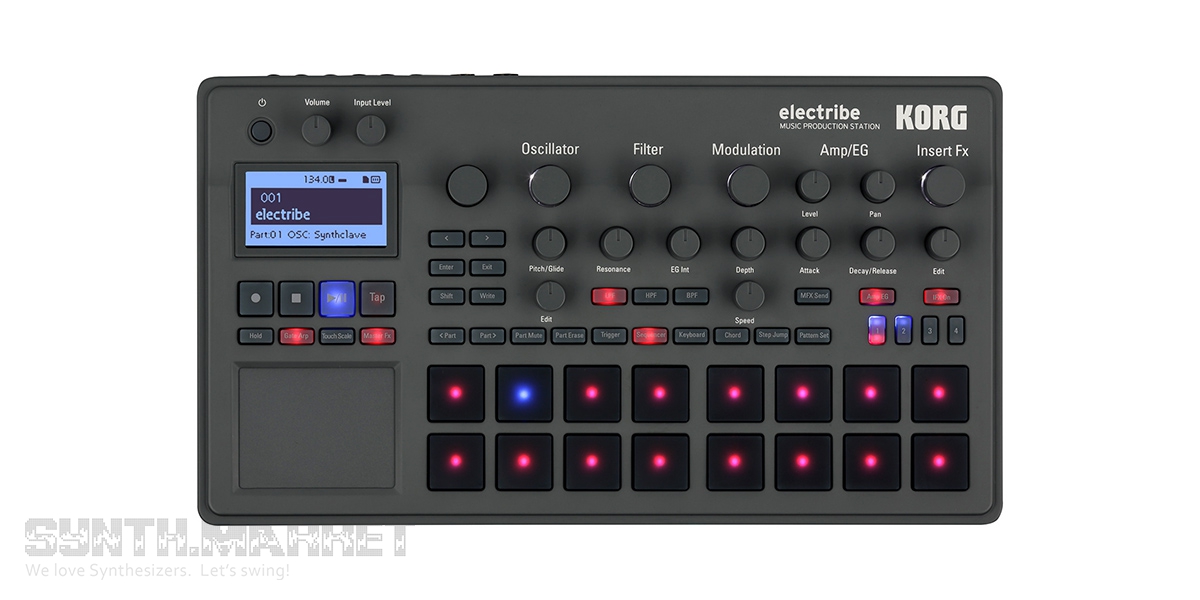
Sixteen years after the first Electribe was released, Korg completely revised and redesigned the line with two new models: the Electribe and the Electribe Sampler, both marketed as "Music Production Stations." This page covers the Synth Electribe, commonly referred to as the Electribe 2 or EMX2. It succeeds the acclaimed ESX1 and EMX1 models, which earned recognition for their direct and intuitive control over sound engines and sequencers, topped off with effects, motion recording, valve circuitry, and individual outputs. The new generation replaces all of that with Korg's latest modelling technology, polyphonic operation, velocity-sensitive drum pads, and the ability to run on batteries — a significant shift in philosophy from immediacy toward performance and portable production.
Design & Build
The Electribe 2 is built around a die-cast zinc chassis, giving it a solid and hefty feel at 1.6 kg despite its ultra-slim profile (339 x 189 x 45 mm). The aesthetic is uniformly grey — grey buttons, grey knobs, grey Kaoss pad, and 16 drum pads in a slightly darker grey rubber — giving it an almost monolithic appearance reminiscent of a soft synth rendered physical. The controls are a mix of knobs and encoders; while closely packed, they inspire confidence. To avoid value jumps during live performance, two modes are available: Catch Mode (no adjustment until the knob physically reaches the stored value) and Value Scale (values change relatively until the knob reaches its maximum extent).
The monochrome LCD display tends to time out and revert to the patch name after parameter adjustments, which is a notable annoyance. Four illuminated encoders help prevent accidentally grabbing the main value encoder — an important safeguard, since doing so mid-performance will silently switch patterns. Visibility in low-light conditions is poor for many controls, particularly the row of buttons used to assign drum pad functionality. The single red LED per active mode button makes distinguishing functions like "Part Mute" from "Part Erase" difficult in dark environments. There is no dedicated Solo button, a departure from previous models. Conversely, the underside of the unit features four multi-colour LEDs that pulse in accordance with the playing pattern — these cannot be disabled except by enabling power-saving mode, which also dims the LCD.
The drum pads are backlit with Red/Blue/Purple LEDs and are velocity-sensitive with four selectable sensitivity levels. The unit shipped with more menu-diving than expected; Korg addressed this partially in the first OS update by adding shortcuts, though opportunities for improvement remain. Functions such as part selection frequently require multiple button presses.
Sound Engine & Oscillators
The Electribe 2 draws from a combination of PCM samples and virtual analogue modelling. Sound creation is divided into five sections: Oscillator, Filter, Modulation, Amp/EG, and Insert FX. There are 409 oscillator types in total, ranging from percussion samples through synth waveforms to the audio input itself. Navigating the list is aided by holding Shift while turning the encoder to jump between categories quickly.
The list opens with 56 PCM bass drums, followed by snares, claps, hi-hats, and a wide variety of percussion including djembes, darbukas, wavedrums, and Latin and synthetic instruments. Classic drum machines are well represented. Synth waveforms begin at oscillator type 326, offering 50 different configurations plus four noise types. Oscillator types cover single analogue waveforms, dual-oscillator layers, pulse-width modulation, VPM (Variable Phase Modulation, similar to FM), oscillator sync, cross modulation, and ring modulation, among others. Korg has drawn from its existing modelling catalogue to deliver these. Each oscillator type exposes a single editable parameter via a dedicated knob — this might be pulse width, detune, sync amount, or distortion depending on the type selected.
From type 381 onwards, multisamples include a cut-down M1 Piano, electric pianos, organ, guitars, breathy pads, and acoustic and electric basses. The multisample set is limited — no choir or strings are included — but hits and orchestral samples round out the selection. The final oscillator type routes the stereo audio input (mixed to mono) as an oscillator source, enabling gating, filtering, and effect processing of external signals.
It should be noted that although the unit advertises polyphony, the synth engine is technically paraphonic: each part shares a common filter, envelope, and velocity. Notes can optionally retrigger the envelope when added to held notes, and two voice-assign modes govern mono behaviour (single or multi-triggering).
Filter
The filter section offers three primary modes — Low-Pass, High-Pass, and Band-Pass — each toggling through multiple filter models on repeated button presses. The Low-Pass button cycles through six options plus off: Electribe, MS20, MG (Moog), P5 (Prophet 5), OB (Oberheim), and Acid (TB303). The Moog variant is exclusive to LPF; all others appear in HPF and BPF modes as well. Controls include a smooth cutoff encoder and a bi-polar envelope depth knob. The Acid filter is the most characterful of the set, with a broken resonance that pushes toward distorted territory. Overall, these are described as the smoothest and warmest filters to appear on any Electribe to date.
Modulation & Envelopes
The amplitude envelope is a two-stage (attack/release) affair, switchable between envelope-based and gated (organ-style) operation. The single modulation bus provides 72 preset source-destination connections, selectable by LFO waveform, BPM-synced LFO, or envelope polarity. Destinations include pitch, filter, level, pan, and the current oscillator or insert effect edit parameter. The LFO covers a wide enough frequency range to encompass both slow sweeps and rapid modulation. The main limitation is the single routing per part. Velocity is notably absent as a modulation source. For additional movement, Motion Recording is available: up to 24 knob movements can be recorded per pattern.
Effects
Each of the 16 parts has its own Insert Effect (IFX), chosen from a list that includes chorus, flanger, phaser, overdrive, punch, bit crush, ring modulator, filters, EQs, the classic Bandpass Plus filter, various delays, slicer, and repeater. Reverb is not available as an insert effect. One global Master Effect (MFX) is available to any part on demand, controlled via the Kaoss pad. The MFX list includes 32 algorithms: three reverbs (Hall, Room, Wet), superior delays, filters, direction switchers, step jumpers, and pattern-mangling effects. Several MFX options affect playback order rather than audio — reversing, doubling, or stepping through selected steps — allowing rhythmic displacement of individual tracks. Performance-oriented tools include a Looper, Pitch Looper (which continue looping after playback stops), and Grain Shifter. The Kaoss pad's X-Y axes map to effect parameters (e.g., reverb decay and mix), with a Hold button to lock a position.
Sequencer
Patterns are a maximum of four bars long. The sequencer supports both step-time (X0X-style) entry and real-time finger-drumming. In step mode, bar selection uses four rubber bar buttons with colour-coded LEDs. Velocity editing is accessible but requires approximately eight button presses to reach. Pseudo-polyphonic recording is supported: up to four notes per step sharing duration and velocity. There is no accent track. Swing and groove are handled via 25 Groove Templates, applicable on a per-part basis, with adjustable depth. Polyrhythms are enabled through a Last Step function that can reduce any part from its default 16 steps. Patterns store tempo and mute states per pattern, making the unit suitable as a master clock, though a global fixed tempo is also available.
Keyboard mode assigns the pads to a chromatic layout over eight octaves (shifted via the four bar buttons). Scale mode assigns a musical scale per pattern, with per-part opt-in. Chord mode turns pads into preset chord inversions within the selected scale, with a density parameter controlling note count. Step Jump mode redirects playback to a chosen step in real time. Pattern Set mode assigns patterns to pads for live selection across up to 64 of the 250 available patterns.
The unit has no song mode. Pattern chaining is not currently supported. Pattern copying between patterns is limited. Saving patterns during playback is possible but not always glitch-free. Pattern switching occasionally produces small but audible timing jumps.
Connectivity & I/O
The rear panel provides stereo quarter-inch audio outputs (left and right). All other connections use 3.5mm jacks: stereo audio input, sync in and out (compatible with Korg Volca range), MIDI In and Out (via included 3.5mm-to-5-pin DIN adapter cables), and a headphone socket. A 9V external PSU socket is also present. There is no MIDI Thru, no individual audio outputs, and no full-size headphone jack. A micro-USB B port on the side enables PC/Mac MIDI connectivity (cable not included). An SD card slot (supporting SD and SDHC cards up to 32GB) is used for pattern backup and export. The unit can run on six AA batteries (NiMH recommended), with approximately five hours of runtime.
Export & DAW Integration
Patterns and ranges of patterns can be exported as 48kHz 16-bit WAV files or as complete Ableton Live sets. Two Live set versions are created: one compatible with the included Ableton Live Lite 9 licence (limited to eight tracks), and one for the full version. Export output is written to the SD card in appropriately named folders. Exported loops occasionally contain clicks due to audio ending at non-zero crossing points. The Master Effect is not included in pattern exports. A full-session performance export is also available, capturing the complete output including Kaoss pad interaction, mutes, and encoder movements; however, this is saved in a proprietary format playable only on the Electribe 2 itself. Individual part backup is possible, but a single-operation full machine backup was not available at time of review.
Parts & Polyphony
The Electribe 2 supports 16 parts and 24 notes of polyphony shared across all parts. Polyphony is consumed by polyphonic recording, processor-intensive oscillator types, and certain filter and insert effect combinations. Parts flagged as high priority are less likely to have voices stolen in dense patterns. There are no kits or saved patches; sounds are assembled per part within each of the 250 available patterns. Copy functionality is limited, and inter-pattern data copying is not supported. Of the 250 factory patterns, the last 50 are initialised and ready to overwrite.
Technical Specifications
Sound Engine
- Polyphony: 24 notes (shared across all parts; paraphonic per part)
- Parts: 16
- Patterns: 250 (200 factory, 50 initialised/blank)
- Pattern Length: Up to 4 bars
- Oscillator Types: 409 (PCM drums, PCM instruments, virtual analogue synth waveforms, audio input)
- Synth Waveform Types: 50 configurations including single analogue waveforms, dual-oscillator layers, PWM, VPM (FM-style), oscillator sync, cross modulation, ring modulation
- PCM Drum Content: Bass drums (56), snares, claps, hi-hats, djembes (4), darbukas (4), wavedrums (8), Latin and synthetic percussion, classic drum machine samples
- PCM Instrument Content: M1 Piano (cut-down), electric pianos, organ, guitars, pads, acoustic and electric basses, hits, orchestral hits, voice samples
- Filter Modes: Low-Pass, High-Pass, Band-Pass (plus off)
- Filter Models per Mode: LPF: Electribe, MS20, MG (Moog), P5 (Prophet 5), OB (Oberheim), Acid (TB303); HPF and BPF: Electribe, MS20, P5, OB, Acid
- Envelope: 2-stage (Attack / Release); switchable between envelope and gate (organ) mode
- Modulation Bus: 1 per part; 72 preset source-destination routings; LFO or envelope as source; destinations include pitch, filter, level, pan, oscillator edit parameter, IFX edit parameter
- Motion Recording: Up to 24 knob movements per pattern
- Insert Effects (IFX): 1 per part; types include chorus, flanger, phaser, overdrive, punch, bit crush, ring modulator, filters, EQ, Bandpass Plus, multiple delays, slicer, repeater
- Master Effect (MFX): 1 global; 32 algorithms including Hall reverb, Room reverb, Wet reverb, delays, filters, direction switchers, step jumpers, Looper, Pitch Looper, Grain Shifter; controlled via Kaoss pad X-Y
- Sequencer Modes: Step-time (X0X), Real-time finger drumming, Keyboard, Chord, Step Jump, Pattern Set
- Step Resolution: 16 steps per bar (adjustable via Last Step per part)
- Polyphonic Step Recording: Up to 4 notes per step (shared duration and velocity)
- Groove Templates: 25 (per-part, with adjustable depth)
- Scales: Multiple presets, assignable per pattern; per-part opt-in
- Chord Mode: Preset inversions within current scale; adjustable note density
- Octave Range (Keyboard Mode): 8 octaves
Pads&Knobs&Display
- Kaoss Pad Size: 50 x 65 mm
- Kaoss Pad Functions: MFX X-Y control, Gate Arp (50 patterns), Touch Scale (1–4 octaves, current scale)
- Drum Pads: 16; velocity-sensitive (4 sensitivity levels); backlit with Red/Blue/Purple LEDs
- Display: Monochrome LCD
Connectivity, Import/Export
- MIDI: In, Out (no Thru); via 3.5mm-to-5-pin DIN adapters; sends/receives MIDI CC per part channel; USB MIDI (micro-USB B)
- MIDI Channels: Up to 16 (one per part); can function as 16-channel MIDI sequencer or multitimbral MIDI module
- Audio Outputs: Stereo L/R, quarter-inch (6.35mm)
- Audio Input: Stereo, 3.5mm (mixed to mono when used as oscillator source)
- Headphone Output: 3.5mm
- Sync I/O: In and Out, 3.5mm (Korg Volca compatible)
- USB: Micro-USB B (MIDI only; cable not included)
- Storage: SD / SDHC card slot (up to 32GB)
- Export Formats: WAV (48kHz, 16-bit), Ableton Live Set (two versions: Lite-compatible and full)
- Performance Export: Proprietary format (Electribe 2 playback only)
Software
- Included: Ableton Live Lite 9 licence
Drawbacs
- Individual Outputs: None
- Song Mode: None
- Pattern Chaining: Not supported
Physical
- Dimensions: 339 x 189 x 45 mm
- Weight: 1.6 kg
- Chassis: Die-cast zinc
- Power: External 9V PSU (included) or 6x AA batteries (~5 hours with NiMH)